Spanish photographer Fernando Moleres has won the 2012 Tim Hetherington Grant, World Press Photo and Human Rights Watch have announced. Moleres was awarded the grant to complete his project called "Waiting for an Opportunity."
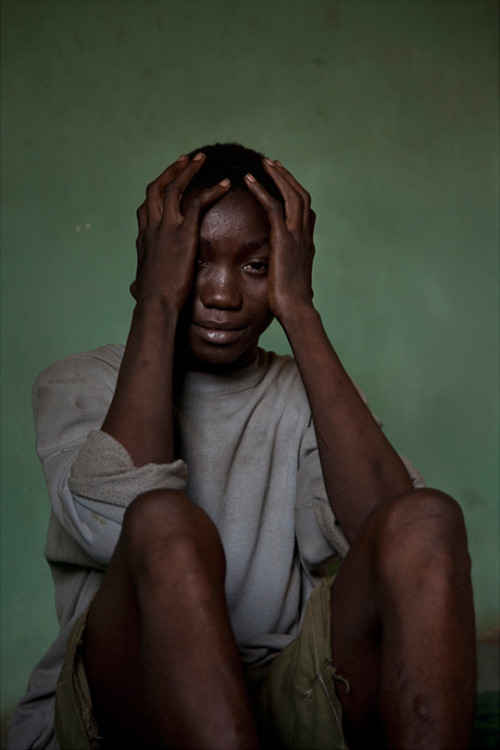
The 20,000 euro grant (about $26,000 USD), established in 2011 to celebrate Hetherington's legacy as a photographer and filmmaker, is intended to help a visual journalist complete an existing project with a human rights theme. Moleres was one of 176 journalists from 53 countries to apply for the grant this year. His project focuses on the hardship and injustice that incarcerated youth are subjected to at an adult prison in Pademba, Sierra Leone. Many wait years for trial under harsh conditions without access to legal assistance. Their families often reject them, and they struggle to re-adjust to prison life after their release. [Via PDN]
 Fernando Moleres / Juveniles in prison

 © Fernando Moleres
 © Fernando Moleres
 Freetown Central Prison in Sierra Leone, designed to hold 220 adult prisoners, currently houses more than 1300 inmates, including boys as young as 14. Up to 60 prisoners share a 270-sq. ft. cell for up to 16 hours a day, sharing a bucket as a toilet.© Fernando Moleres

© Fernando Moleres
 © Fernando Moleres


A prison officer rests in the registration room, among the chaos of the prisoner records. Similar names and surnames, as well as carelessness and negligence on the part of the officers, complicates the process for inmates. Many remain in jail for years before their trial even starts.© Fernando Moleres


The 20,000 euro grant (about $26,000 USD), established in 2011 to celebrate Hetherington's legacy as a photographer and filmmaker, is intended to help a visual journalist complete an existing project with a human rights theme. Moleres was one of 176 journalists from 53 countries to apply for the grant this year. His project focuses on the hardship and injustice that incarcerated youth are subjected to at an adult prison in Pademba, Sierra Leone. Many wait years for trial under harsh conditions without access to legal assistance. Their families often reject them, and they struggle to re-adjust to prison life after their release. [Via PDN]
Mohamed Conteh: Arrested in December 2009 for possession of cannabis he spent four days at the police station without any food. His trial was held without a lawyer of family assistance. He was sentenced to 3 years in Pademba Road prison. Moleres won the World Press Photo 2011 award for the series.© Fernando Moleres


© Fernando Moleres

Inmates play soccer.© Fernando Moleres
A prison officer rests in the registration room, among the chaos of the prisoner records. Similar names and surnames, as well as carelessness and negligence on the part of the officers, complicates the process for inmates. Many remain in jail for years before their trial even starts.© Fernando Moleres
“It’s very difficult to reflect this neglect through photography, In Sierra Leone, a prisoner is nobody, and a young prisoner is nothing.” ~ Fernando Moleres© Fernando Moleres
Juveniles in prision from piaahren on Vimeo.
“Photography has its limits,” says Moleres, who worked as a nurse in Spain before turning to photography. “I’m very happy with the project, it has received a lot of attention, but it’s just a drop in the ocean. Nobody has moved a finger to help these boys.”
Until recently, that is. Moleres returned from another excursion to Freetown just last month, where, with the help of the NGO Free Minor Africa, he gave birth to an organization that will help boys navigate through Sierra Leone’s penal and judicial systems. When fully up-and-running, Moleres hopes to help up to 20 boys, whether they need legal assistance or help with rehabilitation once they are freed from prison. Moleres will also provide them with the option of returning to school or retraining so they may enter the workforce.
Moleres, nonetheless, has no intention of abandoning his photography. He’s currently working on a book that will capture the boys of Pademba Road at various stages of their prison experience, from incarceration to rehabilitation to life on the street.
“If you don’t do anything to follow it up, photography is not worth much,” says Moleres. “We become very conscious of everything but there is little action. I’m more interested in dedicating myself to photographic projects in which action follows close behind.”