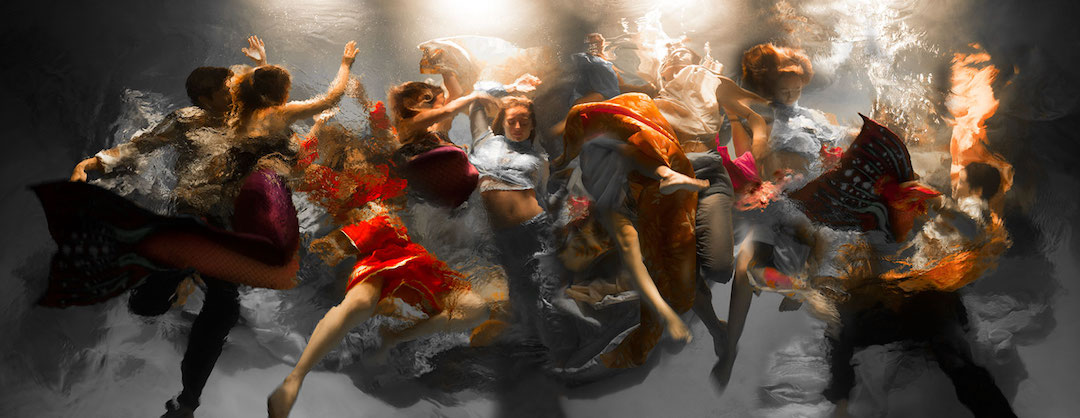
The Hawaiian visual artist produces her colourful, luminous works by submerging her models interlaced bodies, draped in vibrant fabrics, into water and capturing the refraction of light which gives the photographs a painterly effect.
Christy Lee Rogers poolside in between shots.
Nicolas Poussin: A Dance for the Music of Time (c.1634 - 1636
Albert Kahn (1860 -1940) was a French banker and philanthropist, known for initiating The Archives of the Planet, a vast photographical project. Spanning 22 years, it resulted in a collection of 72,000 colour photographs and 183,000 meters of film.
In 1909, Kahn travelled with his chauffeur and photographer, Alfred Dutertre to Japan on business and returned with many photographs of the journey. This prompted him to begin a project collecting a photographic record of the entire Earth. He appointed Jean Brunhes as the project director, and sent photographers to every continent to record images of the planet using the first practical medium for colour photography, Autochrome plates, and early cinematography. Between 1909 and 1931 they collected 72,000 colour photographs and 183,000 meters of film. These form a unique historical record of 50 countries, known as The Archives of the Planet.
Kahn's photographers began documenting France in 1914, just days before the outbreak of World War I, and by liaising with the military managed to record both the devastation of war, and the struggle to continue everyday life and agricultural work [via wiki]
Kahn commissioned four photographers to collect images set specifically in cosmopolitan Paris: Leon Gimpel, Stephane Passet, Georges Chevalier, and Auguste Leon. They utilized pioneering technology that employed colour filters made from microscopic grains of dyed potato starch. The artists began documenting the city in 1914, just days before the outbreak of World War I. The images collected portray the everyday struggle of real life, juxtaposed with a joie de vivre characteristic of Parisians, in a city on the brink of devastation brought on by a war that would alter the world.[via mymodernnet]
The Wonderful World of Albert Kahn Europe on the Brink BBC Documentary
Chilean-bornCamilo José Vergara began photographing American ghettos when he was a Notre Dame undergraduate; he continued while earning a master's degree in sociology at Columbia University. He is best known for his photographs of New York City; his imagery captured the soul and essence of life in the Bronx circa 1970.
His works have been widely exhibited, most recently in the New York Historical Society (Martin Luther King Jr.: The Dream Continues, 2013), the Museum of the City of New York (Tiny Towers: 1970–2011, 2011–12), and the National Building Museum, Washington D. C. (Detroit Is not Dry Bones), 2012; How the Other Half Worships, 2009). Amongst his publications are Harlem: The Unmaking of a Ghetto (forthcoming, 2013), How the Other Half Worships, 2005, The New American Ghetto (1995), and Twin Towers Remembered (2001).
In 2002 Vergara was awarded a MacArthur Foundation "genius" grant and he was awarded the National Humanities Medal by President Obama in 2013.
"East 167th Street, South Bronx." 1973
"Bronx River, Bronx." 1970
"Girls with Barbies, East Harlem." 1970
"Fifth Ave at 110th Street, East Harlem." 1970
"Hoe Avenue at 172nd Street, Bronx." 1970
Teenagers in the Melrose Section, South Bronx, 1970
"Puerto Rican wedding, East Harlem." 1970
"Cadillac Fleetwood, Harlem." 1970
"View of the World Trade Center under construction from Duane Street." 1970