In this fascinating series of New York City Then and Now, historian and photographer Marc Hermann superimposes vintage crime scene photographs with images from the exact locations as they exist today.
"My inspiration is drawn not from fictional characters, but rather from the real people who documented life in New York through the mid-20th century." ~Marc Hermann
Hermann utilized images found on the Daily News Pixphoto archive of the New York Daily News. He then culled historic crime scenes of fires, plane crashes, gas explosions, suicides, and murders, and blended them expertly with the modern scenes of today.
It would be interesting to hear what the current residents of some of these NYC crime scene photograph locations would have to say.
"New York is constantly changing and transforming, and tragedies that affected individuals’ lives are forgotten. We may stand on what was once the site of a horrific murder and not even know it, simply because life goes on."
~ Marc Hermann
Brooklyn, N.Y.
The tree that stands in front of 923 44th St. in Brooklyn is the only living witness to gangster Frankie Yale's untimely demise on July 1, 1928. Yale's car slammed into the steps of the Brooklyn home that day as he was shot to death from a car driving by. .
Pacific St. and Classon Ave. in Brooklyn, N.Y.
The corner of Classon Ave. and Pacific St. got some serious action on July 28, 1957 when a stolen car crashed into a light pole. Strangely enough, the car was allegedly stolen by a boy released from the Brooklyn House of Detention. The boy was initially detained on car theft charges. The corner still looks the same, though new green street signs hang above the scene of the accident
137 Wooster St. Manhattan, N.Y.
Back in the 1950s, there were no North Face storefronts to be found on Wooster St. There was, however, a massive and fatal fire at the Elkins Paper & Twine Co. on Feb. 16, 1958. Six were killed by the blaze and the building was leveled, but new commercial space now stands where the Elkins Paper & Twine Co. once did.
427 1/2 Hicks St. Brooklyn, N.Y.
Gangster Salvatore Santoro met his end in the vestibule of 427 1/2 Hicks St. on Jan. 31, 1957. Here's how the building looks then and now.
M-7 tank in New York City
War in the city? Nope, just an M-7 tank destroyer being transported to be put on display on July 22, 1943. The tank rolled from City Hall to the Public Library on 42nd St .
Porter Ave. Brooklyn, N.Y. Only a few scars left on the side of this building serve as a reminder of what happened here on April 4, 1959. Three-year-old Martha Cartagena was riding her tricycle when she was struck and killed on Porter Ave. in Brooklyn.
497 Dean St. Brooklyn, N.Y. March 19, 1942 is a day well captured in the Daily News' archive. Edna Egbert, who lived at 497 Dean St. in Brooklyn, climbed onto her ledge that day. The News captured the distraught woman fighting with the police as she wobbled on the edge. The building is currently painted red, but remains nearly identical to the way it looked 70 years ago.
992 Southern Blvd. Bronx, N.Y.
A classic case of jealousy. In this stairwell of 992 Southern Blvd. on Sept. 25, 1961, James Linares lay bleeding in the arms of his girlfriend Josephine Dexidor after being shot by her husband. The same banister still scales the length of the hallway.
While digital photography and image-editing software have brought about an increased awareness of the degree to which camera images can be manipulated, the practice of doctoring photographs has existed since the medium was invented. Faking It: Manipulated Photography Before Photoshop at The Metropolitan Museum of Art was the first major exhibition devoted to the history of manipulated photography before the digital age. Featuring some 200 visually captivating photographs created between the 1840s and 1990s in the service of art, politics, news, entertainment, and commerce, the exhibition offered a provocative new perspective on the history of photography as it traces the medium’s complex and changing relationship to visual truth. [via The MET NYC]
If you missed the exhibition do not despair because the book is still available at the Amazon link below:
Unidentified American artist Man on Rooftop with Eleven Men in Formation on His Shoulders c. 1930
Leap into the Void ~ by Yves Klein
As in his carefully choreographed paintings in which he used nude female models dipped in blue paint as paintbrushes, Klein's photomontage paradoxically creates the impression of freedom and abandon through a highly contrived process. In October 1960, Klein hired the photographers Harry Shunk and Jean Kender to make a series of pictures re-creating a jump from a second-floor window that the artist claimed to have executed earlier in the year. This second leap was made from a rooftop in the Paris suburb of Fontenay-aux-Roses. On the street below, a group of the artist’s friends from held a tarpaulin to catch him as he fell. Two negatives--one showing Klein leaping, the other the surrounding scene (without the tarp)--were then printed together to create a seamless "documentary" photograph. To complete the illusion that he was capable of flight, Klein distributed a fake broadsheet at Parisian newsstands commemorating the event. It was in this mass-produced form that the artist's seminal gesture was communicated to the public and also notably to the Vienna Actionists.[via The MET NYC]
Maurice Guibert (French, 1856-1913) Henri de Toulouse-Lautrec as Artist and Model c. 1900
Unidentified artist Man Juggling His Own Head ca. 1880
Io + gatto ~by Wanda Wulz 1932
Wulz, a portrait photographer loosely associated with the Italian Futurist movement, created this striking composite by printing two negatives—one of her face, the other of the family cat—on a single sheet of photographic paper, evoking by technical means the seamless conflation of identities that occurs so effortlessly in the world of dreams.[via The MET NYC]
The Pond - Moonrise ~ by Edward J. Steichen 1904
Using a painstaking technique of multiple printing, Steichen achieved prints of such painterly seductiveness they have never been equaled. This view of a pond in the woods at Mamaroneck, New York is subtly colored as Whistler's Nocturnes, and like them, is a tone poem of twilight, indistinction, and suggestiveness. Commenting on such pictures in 1910, Charles Caffin wrote in Camera Work: "It is in the penumbra, between the clear visibility of things and their total extinction into darkness, when the concreteness of appearances becomes merged in half-realised, half-baffled vision, that spirit seems to disengage itself from matter to envelop it with a mystery of soul-suggestion." [via The MET NYC]
Human Relations ~ by William Mortensen 1932
Mortensen began his career as a Hollywood studio photographer, turning out glamour portraits of stars such as Clara Bow and Jean Harlow. In the early 1930s he established a photography school in Laguna Beach, where he refined and promoted his own aesthetic—an eccentric blend of late Pictorialism, Surrealism, and Hollywood kitsch. Restlessly inventive in the darkroom, he employed a wide variety of techniques, including combination printing, heavy retouching, and physical and chemical abrasion of the negative. At times, his use of textured printing screens gave his photographs the appearance of etchings or lithographs, as in this audaciously grotesque picture, which was prompted, according the artist, by an overcharged long-distance telephone bill.[via The MET NYC]
Uelsmann revived the technique of combination printing pioneered by such Victorian art photographers as Oscar Gustave Rejlander and Henry Peach Robinson in the early 1960s, when darkroom manipulation was denigrated by many proponents of straight photography as a flagrant violation of photographic purity. His pictures, which he creates in a darkroom equipped with seven enlargers, are filled with mind-bending paradoxes, oblique symbolism, and bizarre contrasts of scale. Uelsmann’s work is now considered an important precursor to the seamless compositing widely associated with digital photography and Photoshop.[via The MET NYC]
Jerry N. Uelsmann (American, born 1934)
Untitled
1969
Find ~ Will Connell 1937
In 1938 Connell, an advertising photographer and teacher at the Art Center School in Los Angeles, published In Pictures: A Hollywood Satire, a book of forty-eight photographs that used Surrealist fantasy and photomontage to lampoon the Hollywood studio system. The book offers up a vivid assortment of Tinseltown types: the cigar-chomping producer, the pushy stage mother, and this scantily clad starlet besieged by a horde of colossal sensation-seeking cameras.[via The MET NYC]
John Paul Pennebaker (American, 1903-1953)
Sealed Power Piston Rings
1933
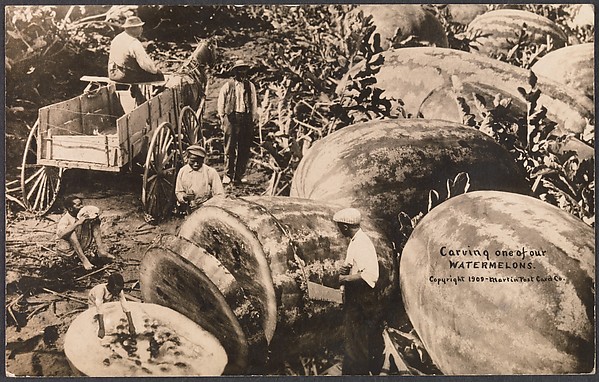
Carving One of Our Watermelons~ by William H. Martin 1909
The tall-tale postcard was a uniquely American genre that flourished in the Midwest between about 1908 and 1915. The earliest master of the genre was William H. “Dad” Martin, a studio photographer in Kansas who established a successful sideline crafting photomontages of outlandish agricultural abundance. Intimately familiar with the tribulations of Midwestern farmers, including a fierce drought that parched the land for most of the 1890s, Martin lampooned the inflated promises of fertile soil, abundant rain, and hardy livestock that land companies used to lure settlers westward.
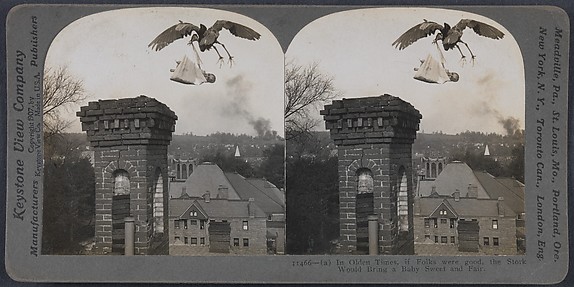
In Olden Times, if Folks Were Good, the Stork Would Bring a Baby Sweet and Fair~ by Keystone View Company, London 1907
A Pair of Hungry Pike ~ by Unknown, Canadian 1911
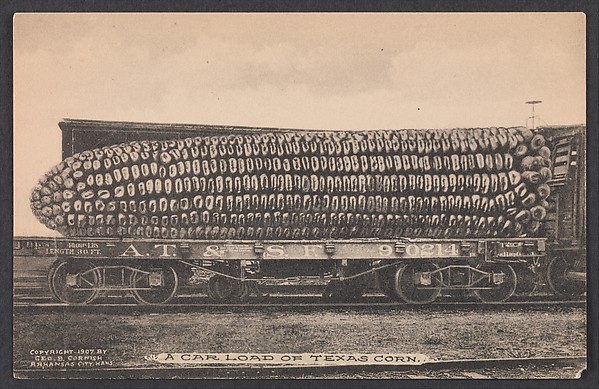
A Car Load of Texas Corn ~ by George B. Cornish 1910
Norman Rockwell: Behind the Camera is the first book to explore the meticulously composed and richly detailed photographs that Norman Rockwell used to create his famous artworks. Working alongside skilled photographers, Rockwell acted as director, carefully orchestrating models, selecting props, and choosing locations for the photographs--works of art in their own right--that served as the basis of his iconic images.
On 6 May 1937, took place a tragedy, caught on film, that haunted the American consciousness for decades.
"The heat was so great that it burned my eyebrows all the way off. ... It has been in my memory forever. It's one of those things you can't forget." ~ Photographer Fred Bamberger
On the rainy day of May 6th, 1937 after working the graveyard shift, Fred Bamberger went to Lakehurst Naval Station in New Jersey. The Hindenburg was expected to land at 7:00 a.m. Lacking an adequate number of active personnel to assist in the landing of the Hindenburg, the local townspeople would be paid $1/hour to help pull down the Zepplins ropes. The Hindenburg's landing would be scheduled at either 7:00 a.m or 7:00 p. m., to fit within the work schedules of the townspeople. Fighting winds all day, the Hindenburg attempted to land at 7:33 p.m. Photographer Fred Bamberger positioned himself one mile away, so he could get the entire Hindenburg in frame. When Fred looked up, he noticed a streak of fire above the fin of the Zepplin. Bamberger put his speed graphic camera to his eye and began photographing. Because of the rain, his camera locked up. Quickly reacting, Fred reached underneath his jacket and whipped out his Zeiss Contax 35mm camera. Witnessing the massive explosion, Fred continued to photograph as the Hindenburg crashed to the ground.
The explosion was so powerful Fred's eyebrows were burned off his face from the hydrogen that kept fueling the burning Zepplin. Shocked in disbelief, Fred moved closer. As he was approaching, he saw people jumping out of the Hindenburg, trying to escape.
``That airship was five city blocks long -- and I was a crazy, aviation- struck kid,`` Bamberger said. ``So I played hooky. I was supposed to be in school that afternoon and at work that night.``
Bamberger shot two rolls of film. By the time he was able to call his boss, it was 1 a.m.
``I was immediately fired for not being at work,`` he said. ``Then I told them I was at Lakehurst and had shot photos, and I was immediately rehired.``
Acme rewarded Bamberger with a bonus -- enough to help him with his tuition and buy a new $200 camera. ``Which for a kid making $15 a day was a lot of money,`` he said.
The tragic story of the Hindenberg in Photographs:
The steel skeleton of "LZ 129", the new German airship, under construction in Friedrichshafen. The airship would later be named after the late Field Marshal Paul von Hindenburg, former President of Germany.
Finishing touches are applied to the A/S Hindenburg in the huge German construction hangar at Friedrichshafen. Workmen, dwarfed in comparison with the ship's huge tail surfaces, are chemically treating the fabric covering the huge hull.
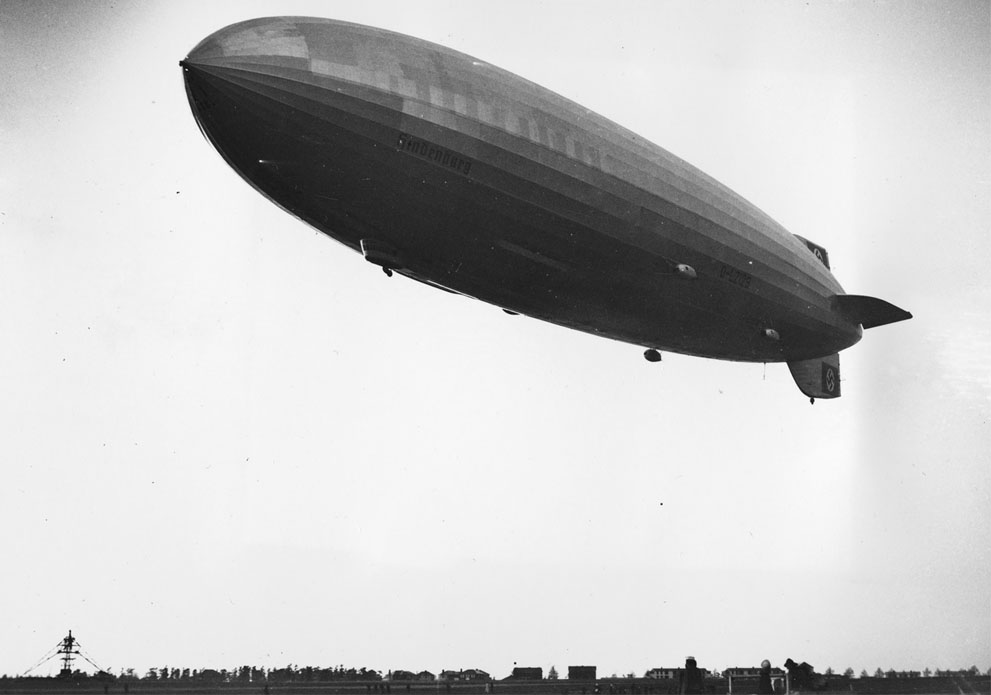
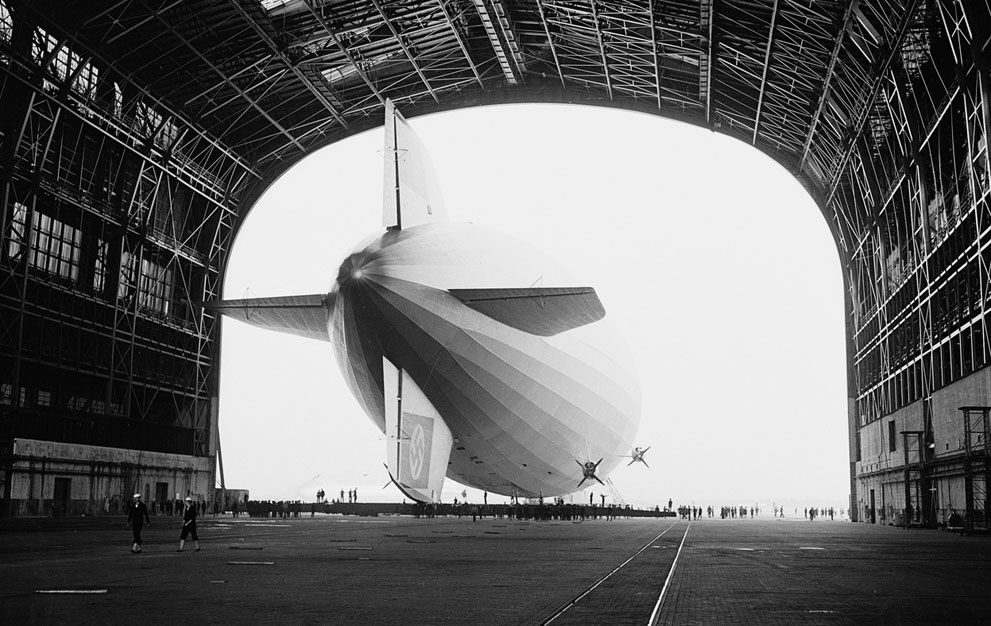
The German-built zeppelin Hindenburg is shown from behind, with the Swastika symbol on its tail wing, as the dirigible is partially enclosed by its hangar at the U.S. Navy Air Station in Lakehurst, New Jersey, May 9, 1936. (AP Photo)
he Hindenburg trundles into the U.S. Navy hangar, its nose hooked to the mobile mooring tower, at Lakehurst, New Jersey, on May 9, 1936. The rigid airship had just set a record for its first north Atlantic crossing, the first leg of ten scheduled round trips between Germany and America. (AP Photo)
The giant German zeppelin Hindenburg, in Lakehurst, New Jersey, in May of 1936. The Olympic rings on the side were promoting the 1936 Berlin Summer Olympics.
Spectators and ground crew surround the gondola of the Hindenburg as the lighter-than-air ship prepares to depart the U.S. Naval Station at Lakehurst, New Jersey, on May 11, 1936, on a return trip to Germany. he Hindenburg dumps water to ensure a smoother landing in Lakehurst, New Jersey, on May 9, 1936. The airship made 17 round trips across the Atlantic Ocean in 1936, transporting 2,600 passengers in comfort at speeds up to 135 km/h (85 mph). The Zeppelin Company began constructing the Hindenburg in 1931, several years before Adolf Hitler's appointment as German Chancellor. For the 14 months it operated, the airship flew under the newly-changed German national flag, the swastika flag of the Nazi Party.
The Hindenburg, above ground crew at the U.S. Navy Air Station in Lakehurst, New Jersey.
A U.S. Coast Guard plane escorts the Hindenburg to a landing at Lakehurst, New Jersey, on its inaugural flight between Freidrichshafen and Lakehurst in 1936. (US Coast Guard)
Passengers in the dining room of the Hindenburg, in April of 1936.
A color photograph of the dining room aboard the Hindenburg.
A modern, electrically equipped kitchen aboard the Hindenburg provided for the passengers and crew
The Hindenburg flies over the Boston Common in Boston, Massachusetts in 1936. Another small plane can also be seen at top right.
Interior of the lounge aboard the Hindenburg, where passenger windows could be opened. (Nationaal Archief/Spaarnestad Photo)
The German zeppelin Hindenburg flies over Manhattan on May 6, 1937. A few hours later, the ship burst into flames in an attempt to land at Lakehurst, New Jersey,
The Hindenburg floats past the Empire State Building over Manhattan on August 8, 1936, en route to Lakehurst, New Jersey, from Germany. (AP Photo)
The Hindenburg floats over Manhattan Island in New York City on May 6, 1937, just hours from disaster in nearby New Jersey.
May 6 2012 marked the 75th anniversary of the Hindenburg disaster. The massive German airship caught fire while attempting to land near Lakehurst, New Jersey, killing 35 people aboard, plus one ground crew member. Of the 97 passengers and crew members on board, 62 managed to survive. The horrifying incident was captured by reporters and photographers and replayed on radio broadcasts, in newsprint, and on newsreels. News of the disaster led to a public loss of confidence in airship travel, ending an era. The 245 m (803 f) Hindenburg used flammable hydrogen for lift, which incinerated the airship in a massive fireball, but the actual cause of the initial fire remains unknown. Gathered here are images of the Hindenburg's first successful year of transatlantic travel, and of its tragic ending 75 years ago.
he Hindenburg quickly went up in flames -- less than a minute passed between the first signs of trouble and complete disaster. This image captures a moment between the second and third explosions before the airship hit the ground. (AP Photo) At approximately 7:25 p.m. local time, the German zeppelin Hindenburg burst into flames as it nosed toward the mooring post at the Naval Air Station in Lakehurst, New Jersey, on May 6, 1937. The airship was still some 200 feet above the ground.(AP Photo/Murray Becker)
As the lifting Hydrogen gas burned and escaped from the rear of the Hindenburg, the tail dropped to the ground, sending a burst of flame punching through the nose. Ground crew below scatter to flee the inferno.
The wreckage of the Hindenburg in Lakehurst, New Jersey, on May 6, 1937. (AP Photo/Murray Becker)
A portion of newsreel coverage as the front of the flaming Hindenburg crashes to the ground, with passengers and crew running for their lives.
A survivor flees the collapsing structure of the airship Hindenburg. (Note, the hand-retouching in this photo came from the original)
Major Hans Hugo Witt of the German Luftwaffe, who was severely burned in the Hindenburg disaster, is seen as he is transferred from Paul Kimball Hospital in Lakewood, New Jersey, to another area hospital, on May 7, 1937. (AP Photo)
An unidentified woman survivor is led from the scene of the Hindenburg disaster at the U.S. Naval Station in Lakehurst, New Jersey, on May 6, 1937. (AP Photo/Murray Becker)
Adolf Fisher, an injured mechanic from the German airship Hindenburg, is transferred from Paul Kimball Hospital in Lakewood, New Jersey, to an ambulance going to another area hospital, on May 7, 1937. (AP Photo)
Members of the U.S. Navy Board of Inquiry inspect the wreckage of the German zeppelin Hindenburg on the field in New Jersey, on May 8, 1937. (AP Photo)
Customs officers search through baggage items salvaged in the Hindenburg explosion in Lakehurst, New Jersey, May 6, 1937.
Two men inspect the twisted metal framework of the Hindenburg in New Jersey in May of 1937. (AP Photo)
n New York City, funeral services for the 28 Germans who lost their lives in the Hindenburg disaster are held on the Hamburg-American pier, on May 11, 1937. About 10,000 members of German organizations lined the pier. (AP Photo/Anthony Camerano)
German soldiers give the salute as they stand beside the casket of Capt. Ernest A. Lehmann, former commander of the zeppelin Hindenburg, during funeral services held on the Hamburg-American pier in New York City, on May 11, 1937. The swastika-draped caskets were placed on board the SS Hamburg for their return to Europe.
Surviving members of the crew aboard the ill-fated German zeppelin Hindenburg are photographed at the Naval Air station in Lakehurst, New Jersey, on May 7, 1937. Rudolph Sauter, chief engineer, is at center wearing white cap; behind him is Heinrich Kubis, a steward; Heinrich Bauer, watch officer, is third from right wearing black cap; and 13-year-old Werner Franz, cabin boy, is center front row. Several members of the airship's crew are wearing U.S. Marine summer clothing furnished them to replace clothing burned from many of their bodies as they escaped from the flaming dirigible. (AP Photo)
An aerial view of the wreckage of the Hindenburg airship near the hangar at the Naval Air station in Lakehurst, New Jersey, on May 7, 1937. (AP Photo/Murray Becker)
1937 Newsreel Complete Report: The Hindenburg Burning:
Rare colour footage of the Hindenburg Footage of the Hindenburg over NYC







+airship+of+the+Zeppelin+Transport+Comnpany+landing+at+airship+port+upon+return+from+commercial+flight+to+England+1936.jpeg)