About Me

My photo
Toronto, Ontario, Canada
"To take a photograph is to align the head, the eye and the heart. It's a way of life." ~ Henri Cartier-Bresson
Showing posts with label tattoo. Show all posts

Tuesday, December 10, 2019

1940's Yakuza Tattoo Culture ~ Horace Bristol


Born in 1908, Horace Bristol studied at the Art Center of Los Angeles, where he was influenced by the work of Edward Steichen and Margaret Bourke-White. He moved to San Francisco, met Ansel Adams and through him befriended fellow photographers including Edward Weston, Dorothea Lange, and Imogen Cunningham.

He became a LIFE magazine contributor in the late 1930s and was soon hired on staff. In 1937 Bristol proposed a story about migrant farm workers in California’s Central Valley—a project that would include accompanying text by novelist John Steinbeck. LIFE turned down the story and Steinbeck withdrew from the partnership to write the story as a novel, which became his masterpiece The Grapes of Wrath but Bristol photographed the region on his own.

In 1941 Bristol became one of five photographers documenting World War II under the direction of Edward Steichen, and he photographed battles in North Africa, Okinawa, and Iwo Jima.

Following his documentation of World War II, Bristol settled in Tokyo, Japan, selling his photographs to magazines in Europe and the United States, and becoming the Asian correspondent to Fortune. He published several books, and established the East-West Photo Agency.

 In 1956, devastated by the suicide of his wife, Bristol burned all the negatives and photographs that he kept at his seaside house in Japan, effectively ending one of the most intense photographic careers of his time. His remaining photographs were packed into footlockers, stored, and left untouched for nearly thirty years. Below are some of his stunning documentation of mid-century tattoo culture in Japan.


Horace Bristol, Yakuza Public Baths, Japan, 1947


During the Edo period (1603 to 1868), criminals in Japan were tattooed by authorities in a practice known as bokkei, making it hard for them to reenter society and find work. This is a primary reason why the tattoo culture of the Yakuza evolved in protest to this branding.
The meaning of Yakuza tattoos are usually related to imagery and symbolism in Japanese art, culture, and religion. The full body suit tattoo, in particular, is a product of Yakuza culture. In the past, it was obligatory in many Yakuza clans for members to get tattoos.
In modern times, the practice is no longer as common. Many Yakuza in the 21st century maintain clean skin to better blend in with society. Conversely, more and more non-Yakuza in Japan are getting tattoos.
Despite these changes, being tattooed is considered a rite of passage for the Yakuza.


1946, Tokyo, Japan ~ A Japanese tattoo artist works on a group of  Yakuza gang members.


Friday, September 2, 2011

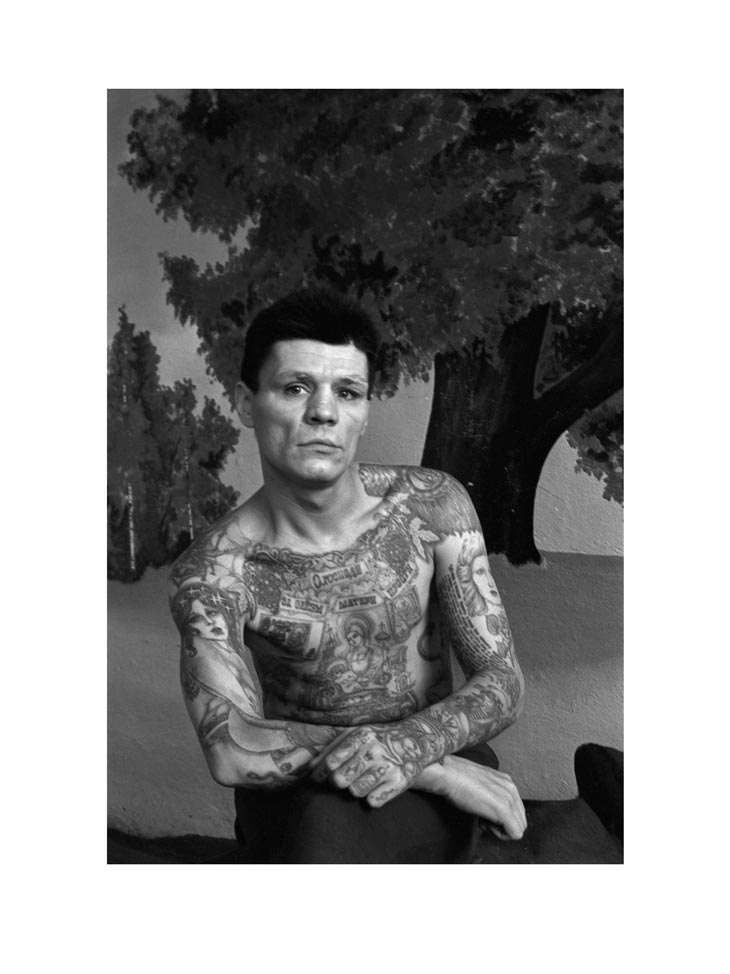
Photographer Sergei Vasiliev’s Russian Criminal Tattoo Encyclopaedia

Sergei Vasiliev‘s photographs of Russian Criminal Tattoos are part of a three part encyclopaedia/archive on the subject. Vasiliev photographed in prisons and reform settlements across Chelyabinsk, Nizhny Tagil, Perm and St. Petersburg between 1989 and 1993. 


(David Cronenberg  made regular use of the Encyclopaedia during the making of his 2007 movie Eastern Promises).


Tattooing was illegal in prisons, so prisoners made tattoos by melting down boot heels and mixing the solution with blood and urine.


The Soviet dissident and writer Eduard Kuznetsov writes about a con who was operated on by prison authorities three times against his will to remove a tattoo on his forehead. The first tattoo read: Khrushchev's Slave. The second: Slave of the USSR. The third: Slave of the CPSU (Communist party). "Now, after three operations," wrote Kuznetsov, "the skin is so tightly stretched . . . he can no longer close his eyes. We call him The Stare."


The meticulous ink drawings of tattoos made by Danzig Baldaev, a prison guard from 1948 to 1986 appear in the Encyclopaedia. Over 3,000 tattoos were accumulated over a lifetime by the prison attendant .Tattoos were his gateway into a secret world in which he acted as ethnographer, recording the rituals of a closed society. The icons and tribal languages he documented are artful, distasteful, sexually explicit and sometimes just strange, reflecting as they do the lives and traditions of Russian convicts. Skulls, swastikas, harems of naked women, a smiling Al Capone, medieval knights in armor, daggers sheathed in blood, benign images of Christ, sweet-faced mothers and their babies, armies of tanks and a horned Lenin: these are the signs by which the people of this hidden world mark and identify themselves.


A criminal with no tattoos was devoid of status, but to have a tattoo when you hadn't earned it – bearing the skull sign of a criminal authority, for example – often resulted in the tattoo being forcibly removed with a scalpel by fellow prisoners.


Tiger signifies an 'enforcer'


A cross worn on the chest signifies a "Prince of Thieves," the highest possible rank.


Barbed wire across ones forehead usually indicates a life-term in prison.


Here is a great documentary on the Russian Prison system:


Part of a special on Russian Mafia with an Interview with Danzig Baldaev, the guard who made the drawings for the Tattoo Encyclopaedia.

Russian Criminal Tattoo Encyclopaedia Limited Edition Boxed Set

Wednesday, August 3, 2011

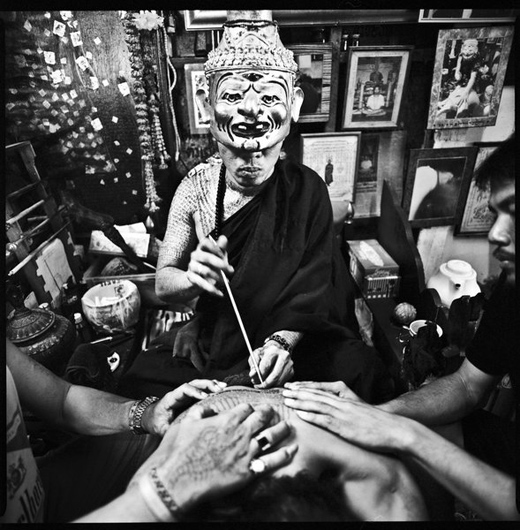
Sacred Ink ~ By Photographer Cedric Arnold

Born in 1976, French-British photographer Cedric Arnold first picked up a 35mm camera at university, whilst studying linguistics and history in Paris. He quickly turned most of his attention to photography and filmmaking, taking extra credits in printmaking, the history of cinema, and documentary filmmaking.


After graduating, Cedric moved to London to present his work. He started freelancing for agencies and magazines, splitting his time between London and Northern Ireland, later joining the agency Sygma. Trips to Thailand and Cambodia soon persuaded him that a move to South East Asia was what he wanted. Cedric eventually made Bangkok his base in late 2001, and has since been producing work for international publications as well as for exhibits; working with clients such as The New York Times, Wall Street Journal, the Rotary Foundation, Cartier, and The National Geographic Channel.

The ‘Sacred Ink’ project was photographed with a wide array of camera systems ranging from large format to Polaroid cameras as well as square format and modified cameras


Yantra tattooing, also called sak yant (Thai: สักยันต), is a form of sacred tattooing practiced in Southeast Asian countries including Cambodia, Laos, and Thailand. Sak means "to tap [tattoo]", and yant, derived from the Sanskrit word yantra, means "sacred geometrical design."
Sak yant designs are normally tattooed by wicha (magic) practitioners and Buddhist monks, traditionally with a long bamboo stick sharpened to a point (called a mai sak) or alternatively with a long metal spike (called a khem sak).


Yantra tattoos are believed to be magic and bestow mystical powers, protection, or good luck